

Cold-pressed from the flesh of Persea gratissima, avocado oil is gaining recognition not as a fragrance oil in its own right, but as one of the most functionally versatile carrier oils in professional and at-home body care. Rich in oleic acid, linoleic acid, and fat-soluble vitamins, it offers a distinctive combination of deep nourishment, substantial massage glide, and neutral compatibility with essential oil blends.
Avocado oil is a fixed, pressed vegetable oil rather than an essential oil. Its cosmetic identity is defined by its fatty acid profile: approximately 60% oleic acid, 15% linoleic acid, and 15% palmitic acid, alongside phytosterols, squalene, tocopherols, and carotenoids. This composition gives avocado oil its characteristic weight and emollient behavior—richer than sweet almond or grapeseed oil, with a texture that some practitioners describe as “substantial” or “conditioning” on the skin. The oil is available in refined and unrefined forms; refined avocado oil is pale yellow and nearly odorless, while unrefined oil retains a deeper green hue and a faint nutty aroma.
The following sections outline how avocado oil is used across three domains of body care, with practical guidance on application and formulation.
Massage: Substantial Glide and Sustained Conditioning
In massage therapy, avocado oil is valued for a quality that lighter carrier oils often lack: body. Its richer texture provides excellent slip and glide during facial and bodywork, while leaving the skin feeling soft and conditioned rather than stripped or greasy. Because it is naturally high in oleic acid, avocado oil functions as a strong occlusive and emollient, forming a film that slows transepidermal water loss and supports the skin’s lipid barrier during and after treatment.
For professional or at-home massage, avocado oil can be used alone or blended with a lighter carrier oil to adjust glide and absorption. Spa practitioners often incorporate it at approximately 10% of a base oil blend to add richness without overwhelming the formula. When essential oils are added, the standard dilution framework applies: roughly 12–15 drops of essential oil per 30 mL of avocado oil yields a 2–2.5% dilution suitable for body massage, while a 1% dilution (5–6 drops per 30 mL) is more appropriate for facial work. Citrus, floral, herbal, and woody essential oils blend harmoniously with avocado’s neutral-to-subtle aromatic profile.
Skincare: Barrier Support and Deep Nourishment
Avocado oil’s skincare value lies in its ability to replenish and soften compromised or undernourished skin. It is an excellent source of skin-replenishing fatty acids, including omega-3 linolenic acid, omega-6 linoleic acid, and oleic acid, which work on the skin’s surface to preserve moisture and prevent water loss. The oil is also a natural source of antioxidants—vitamins A, C, D, and E—along with lecithin and polyphenols that help neutralize free radicals before they can damage skin. On compromised skin, avocado oil has been shown to boost hydroxyproline content, an amino acid that contributes to a firmer feel and a strengthened barrier.
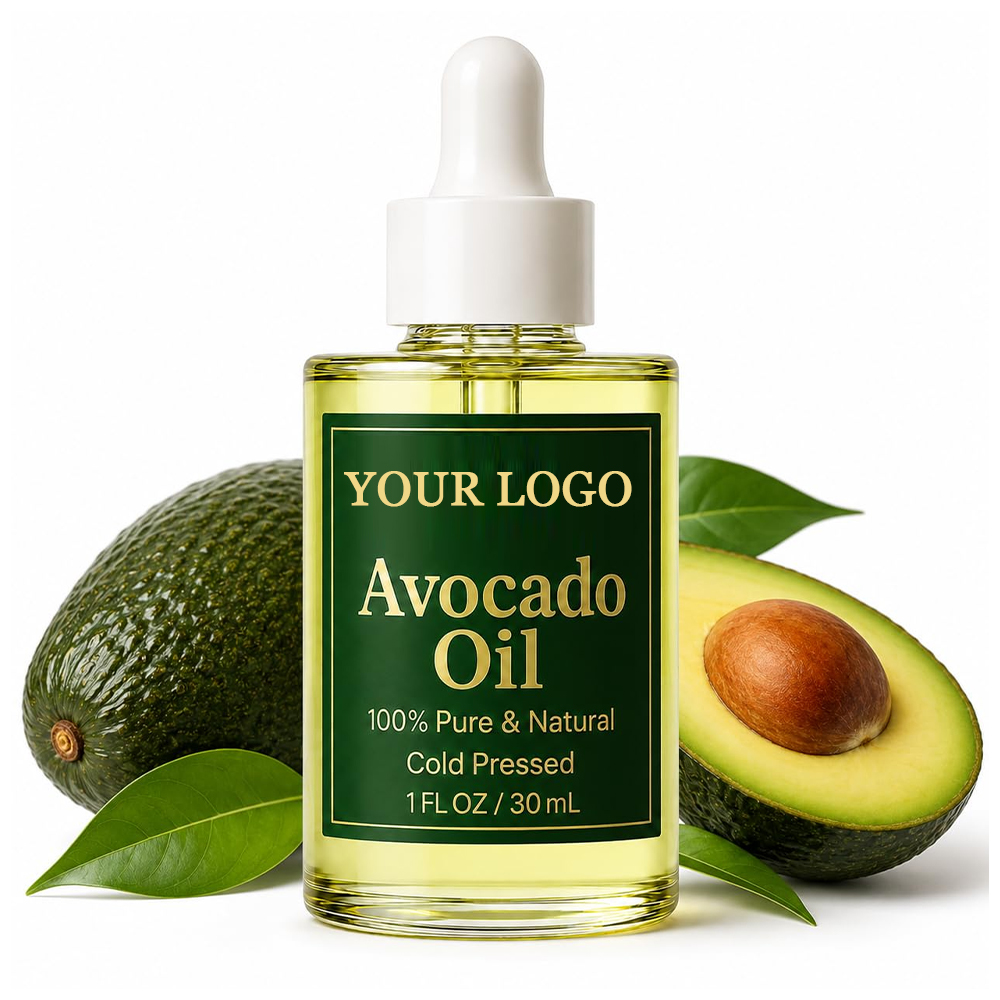
These properties make avocado oil particularly suited to dry, dehydrated, and mature skin, as well as to skin experiencing barrier impairment. It is commonly used in rich moisturizers, facial oils, and body balms at concentrations ranging from 1% to 20%. For daily facial application, a low concentration or a blend with a lighter oil is advisable; for body care, it may be used more generously. Those with oily or blemish-prone skin should approach higher concentrations with caution, as the oil’s high oleic acid content can feel heavy on clog-prone skin, though low concentrations pose little comedogenic risk.
Aromatherapy: A Quiet, Functional Carrier
Avocado oil does not perform as an aromatic agent; it performs as a delivery system. In aromatherapy, its role is to dilute concentrated essential oils to safe skin-contact concentrations while contributing its own nutritional profile to the finished blend. Refined avocado oil is often preferred for aromatic blends because its pale color and subtle scent do not compete with the fragrance of the essential oils being carried. Unrefined oil, by contrast, brings a deeper color and faint nutty note that may complement earthy or woody blends but can obscure delicate florals and citruses.
A practical aromatherapy dilution guide: 3 drops of essential oil per teaspoon (5 mL) of avocado oil yields roughly a 3% blend, appropriate for localized body application; 5 drops per 2 tablespoons (30 mL) yields a gentler approximately 0.8–1% blend suitable for facial or sensitive-area use. Avocado oil’s richer texture makes it especially useful in night-time or cold-weather blends, where a slower-absorbing carrier extends the aromatic experience and supports skin conditioning overnight.
Mobile:+86-15387961044
Whatsapp: +8618897969621
e-mail: freda@gzzcoil.com
Wechat: +8615387961044
Facebook: 15387961044
Post time: Nov-11-2026