

Cedarwood oil remains one of aromatherapy’s most dependable “base-note” botanicals—valued less for dramatic claims than for the steady, grounding presence it brings to a massage blend, a facial oil, or a diffuser. Its warm, balsamic woodiness and its documented effects on the nervous system make it a practical tool for slowing down. Responsible use still begins with dilution, species awareness, and individual caution.
Cedarwood essential oil is steam-distilled from the wood, bark, or sawdust of trees that carry the name “cedar,” though the label covers two distinct botanical families. True cedars—Cedrus atlantica (Atlas cedar) and Cedrus deodara (Himalayan cedar)—belong to the pine family and yield oils rich in himachalenes and atlantones, with a deep, rounded, slightly sweet aroma. Virginian cedarwood (Juniperus virginiana) and Texas cedarwood (Juniperus mexicana) come from the cypress family and are technically junipers; they are richer in cedrol and thujopsene, with a drier, sharper, “pencil-shaving” woodiness. The Latin name on the bottle is the only reliable guide to which oil a user is actually holding. The following sections outline how cedarwood is used in massage, skincare, and aromatherapy, with practical guidance on dilution and application.
Massage: Grounding Touch for Tense Bodies and Busy Minds
In massage practice, cedarwood is chosen for its ability to settle the nervous system as much as for its effect on muscle tissue. Aromatherapy references consistently describe it as grounding and calming, useful for easing nervous tension and promoting relaxation. Its sesquiterpene content is associated with a sedative, calming action on the nervous system, and practitioners often incorporate it into blends for clients who arrive both physically tight and mentally “wound up.”
Dilution guidance varies slightly by source but converges on a moderate range. A commonly cited preparation is 5 drops of cedarwood in 10 mL of carrier oil, roughly a 2.5% dilution; a larger batch uses 12–15 drops in 30 mL of sweet almond or jojoba oil for a full-body massage. Some suppliers recommend a lighter touch for sensitive skin: up to 3 drops per tablespoon (15 mL) for adults with reactive skin, and no use on children under two years old. Cedarwood blends well with patchouli, benzoin, vetiver, and rose, and its dry woodiness is often used to anchor lighter citrus or floral top notes in a massage blend.
Skincare: Sebum Balance and Clarifying Support
In cosmetic applications, cedarwood is most often selected for oily and blemish-prone skin. Virginian cedarwood in particular is described as antiseptic, astringent, and anti-seborrhoeic—that is, capable of helping regulate sebum production—which makes it relevant to acne-prone skin, dandruff, and seborrhoeic eczema. Formulators also cite its mild antimicrobial and anti-inflammatory properties, with in vitro work on Cedrus atlantica showing activity against skin-relevant bacteria alongside antioxidant capacity. Its astringent action is valued for helping to reduce the appearance of excess oil and to promote a clearer-looking complexion.
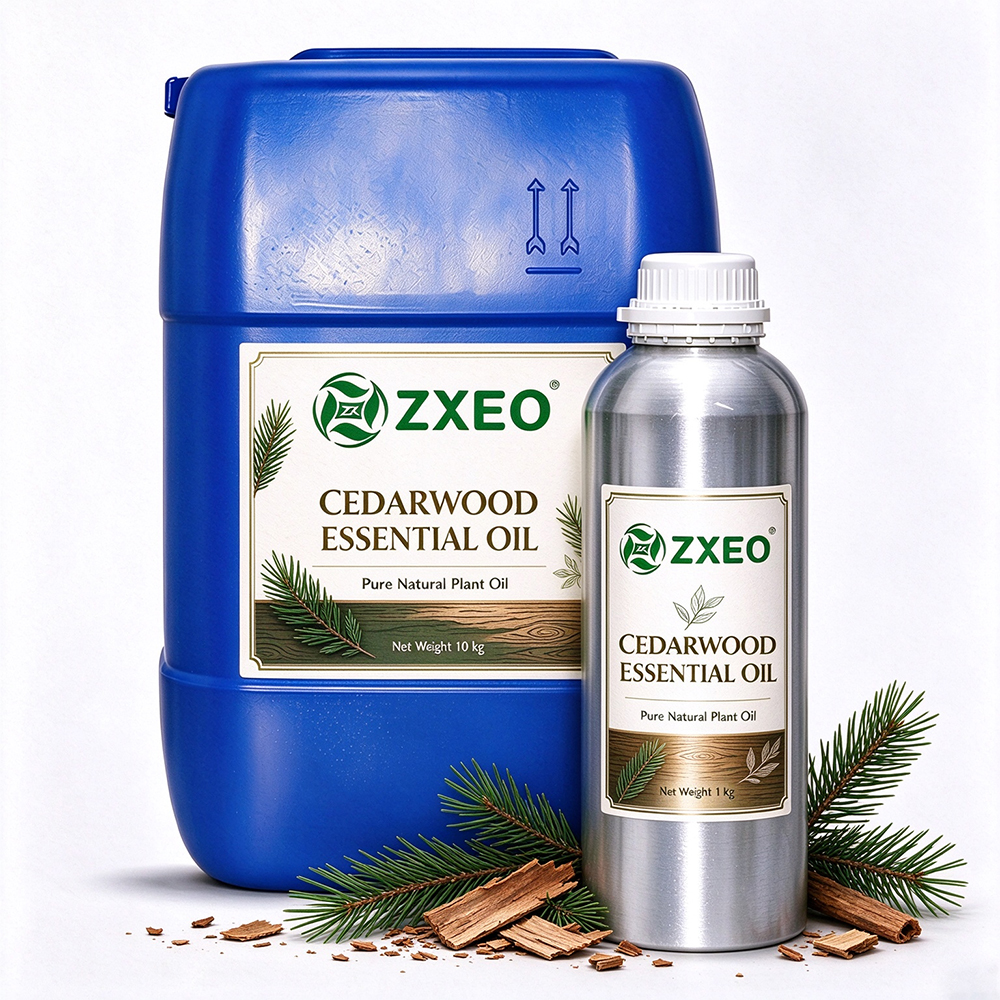
For facial use, a 1% dilution is the standard starting point: approximately 5–6 drops per 30 mL of carrier oil. Body preparations may use 2%, or 10–12 drops per 30 mL. For oily or combination skin, a lightweight carrier such as jojoba or argan oil is preferable to a heavy base, since the goal is to balance rather than occlude the skin. A patch test on the inner forearm is advised before first facial application, and the oil should be kept away from the eyes and broken skin. Cedarwood can also be added to a scalp treatment or shampoo base at a low percentage for flaking and oiliness, though it should not be applied neat to the scalp.
Aromatherapy: Calm Alertness and Sleep Support
Cedarwood’s most studied effect is its action on the autonomic nervous system. In a controlled human study, inhalation of cedrol—the principal active compound in cedarwood oil—significantly lowered heart rate and both systolic and diastolic blood pressure compared with breathing plain air. The proposed mechanism is a shift toward parasympathetic “rest and digest” activity and a corresponding reduction in sympathetic arousal. A 2021 systematic review of aromatherapy inhalation research likewise associated essential oil inhalation, including cedarwood, with better sleep quality, lower stress levels, and reduced fatigue, while noting that separating direct pharmacological effects from the relaxation of the ritual itself is difficult.
Practically, cedarwood is diffused at 3–5 drops in a water-based diffuser for a calming atmosphere, and it is often paired with lavender, bergamot, or vetiver for evening blends. Its profile is frequently described as promoting a “steady, calm alertness” rather than sedation—useful for meditation, focused work, or the transition toward sleep rather than as a sleep aid alone. For a more localized application, a few drops can be added to a steam inhalation for respiratory ease, or to a bath when first dispersed in a carrier oil or bath milk.
Mobile:+86-15387961044
Whatsapp: +8618897969621
e-mail: freda@gzzcoil.com
Wechat: +8615387961044
Facebook: 15387961044
Post time: Nov-20-2026